
Monroe County Property Value Types
A Monroe County property value can surface in several places. The assessor record is one source. So are the tax bill, the DOR ratio report, and the deed index. Where a number comes from matters as much as the amount itself. Municipal assessors set the parcel assessments. The county links visitors to tax and parcel information. The Register of Deeds records the instrument along with any stated consideration. Put those origins side by side before drawing a conclusion. Live parcel cards vary in how they label values and sale history. Open the selected record and confirm it rather than assuming everything appears on one screen.
| Value | What It Is | Where |
|---|---|---|
| Assessed value | Value assigned for property-tax administration. | Local assessor / assessment roll. |
| Estimated fair-market value | Assessment interpreted through the district's level. | Tax bill / DOR method. |
| Recorded consideration | Amount stated for a recorded transfer, when entered. | Deed instrument / index. |
| Land and improvements | Separate assessment components where the roll shows them. | Assessment roll. |
The assessed value is not automatically a sale price. A family transfer can distort it. So can an entity change, a parcel allocation, or a nominal amount, which makes recorded consideration a weak market comparison. Wisconsin's assessment ratio also varies parcel by parcel. A municipal aggregate ratio is not an individual appraisal. Before comparing two figures, ask who produced each one, what year it covers, and whether it describes one parcel or a whole municipality. The local assessor prepares the assessment for property-tax administration. A deed's consideration is tied to the instrument filed with the Register of Deeds. The Department of Revenue's equalized value is a separate statewide measure. All of these values can be correct while answering different questions.
Looking Up a Monroe County Property Value
Start with the county-linked Beacon or Tax Parcel Search. Identify the land there. Then confirm the municipality and the assessment year. The Beacon result list may display ASV, a parcel key, owner text, and STR. Detail-card labels vary. A field may be unclear in the live record. Ask the local assessor. Remember that the county parcel layer and the local assessment function are different roles. Keep the parcel number and legal description with your notes. That way the right value carries to the right tax year. Use the municipality field to find the assessor responsible for that parcel. A property may have been divided, combined, or annexed. Compare the current description with the assessment roll. Then treat its total as like-for-like. The county-linked search helps identify and map the account. Questions about how a number was set belong to the local assessor. That assessor is named for the taxation district.
- Find the parcel by situs address or parcel ID in Beacon or the Treasurer's tax links.
- Confirm municipality, assessment year, legal description, and ASV.
- Ask the local assessor to explain a value field not shown in the public result.
- Use a deed's recorded consideration only as transfer context, not as an appraisal.
- Assessed value
- A local assessment used in the tax system.
- Market value
- An estimate of current value under market conditions.
- Assessment ratio
- For a parcel, assessed value divided by current market value.
- Aggregate ratio
- A municipality-level comparison with DOR equalized value.
- Consideration
- The amount stated in a transfer record, subject to transaction context.
Monroe County Assessment Ratios
Wisconsin DOR separates a parcel's individual ratio from a municipality's aggregate ratio. The individual measure is simple. Divide the parcel's assessed value by its current market value. The municipal aggregate ratio works at a larger scale. It compares local assessed totals against the DOR nonmanufacturing equalized-value base. That municipal level is an average. It does not mean every property carries the same assessment ratio. The DOR aggregate-ratio explanation lays out the state method for reading these local comparisons.
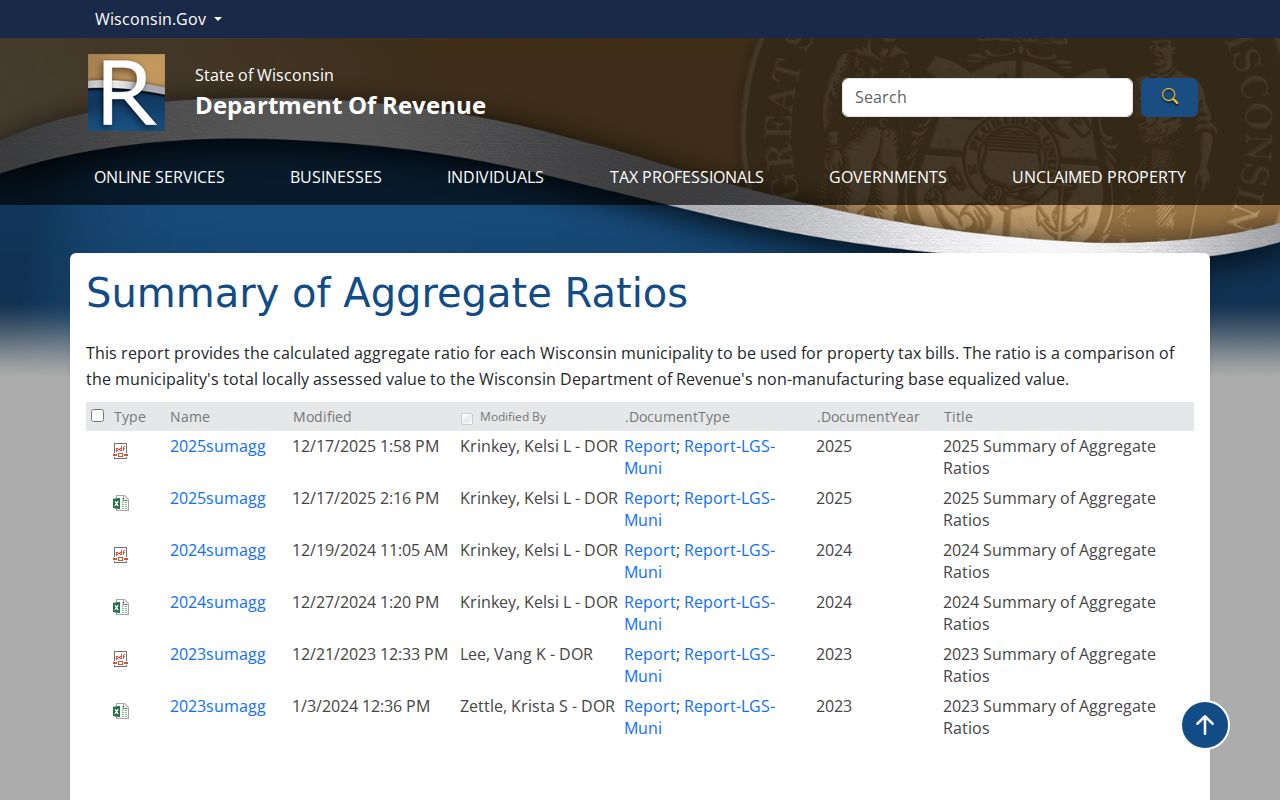
Use a municipality report to read a district-level pattern. Then return to the local assessor for the parcel's own record. An aggregate ratio is a broad diagnostic. It shows how local assessment totals relate to the DOR equalized-value base. It can signal that a municipality's assessment level sits apart from a statewide comparison point. It cannot correct an individual parcel value by itself. Check the report year and municipality carefully. A countywide average should never be applied mechanically to one Monroe County property. The same goes for a neighboring town's figure.
January 1 Monroe County Values
Wisconsin's assessment manual covers the estimated fair-market value on a tax bill. It defines that figure as the assessed value divided by the taxation district's level of assessment. It is a January 1 approximation. It is not an appraisal. It is not a prediction of a later sale. Keep the date tied to the number whenever it is copied into a comparison. A later deed may report consideration from a transaction that occurred after the assessment date. The two amounts describe different moments. They may also use different methods. A figure can look surprising. Verify the tax year and the local assessment notice before interpreting the gap. The January 1 date matters for another reason. A bill issued later can reflect a valuation snapshot. That snapshot may differ from the property's condition on the day the bill is opened. Improvements, damage, a changed use, or a later transfer may all come after that snapshot. Ask the local assessor which record date and property characteristics sit behind the figure. Keep the notice with its tax year when comparing it to later data.
Monroe County Sale Consideration
A deed's stated consideration deserves a careful read. The amount can be nominal, left blank, or split across several parcels. Family transfers and entity reorganizations also distort the figure. Treat the recorded number as transfer context. Do not treat it as proof of an ordinary market sale at that price.
Comparing a deed against the assessor's property value takes two checks. Verify the property description first. Then confirm the recording date. Beacon does not guarantee a sale-history field. Monroe County's detail card may not show one. The Register of Deeds image remains the record of what was filed. The assessor holds the assessed figure.
Sparta and Tomah Value Context
Sparta's equalized value, net of TID increment, sits at $420,777,400 in the county's 2024 apportionment report. That gives Sparta an 8.4227115% share of the apportionment table. Keep the figure in perspective. It is an aggregate used to apportion taxes across municipalities. It is not a home value or a market-price estimate for any individual property.
Tomah's 2023 assessment roll shows parcel-level detail better. Each entry lists the owner, property description, district, class, acres, land value, improvements, and total. Those fields reveal how a single property value is recorded. For wider municipal context, check the DOR ratios. Neither a citywide trend nor a planning proposal predicts what one home will fetch.
Tomah's planning file contains a 2025 land-use amendment. It also holds an inquiry about possible development of 400 to 700 units by 2030. Those are planning signals only. Nothing has been built. A proposed project can raise fair questions about zoning, roads, and services, but it says nothing about an existing parcel's worth. Read the underlying city record and the parcel's own assessment before concluding anything.
Monroe County Value and Tax Records
Assessment interpretation and the tax bill are related but separate subjects. The tax record carries installment amounts, district components, credits, and payment status. The Monroe County property tax records page works through those bill and review details. It never mistakes the assessed value for a sale appraisal.
For the parcel itself, the Monroe County property search route shows how to identify the parcel. It also shows how to carry its key across the different systems. Always confirm the assessment year before comparing figures from separate reports.
An assessment that looks off needs the right paper trail. Get the notice and ask the local assessor about the value and the property description. Wisconsin's property-owner guidance outlines the review and Board of Review process. Monroe County sets no single countywide objection date. So check the current notice and your municipality's schedule before submitting evidence. Paying the Treasurer does not substitute for the assessor's review.
What Monroe County Assessed Value Cannot Tell You
A Monroe County assessed value is a tax-system figure, nothing more. It will not tell you what a buyer will offer. It will not tell you what a lender will accept. And it will not match what a licensed appraiser concludes for a specific sale. The county follows no single reassessment schedule across every municipality, so rely on the current notice and your local assessor rather than assuming a uniform cycle.
Use the assessment record to understand the public valuation basis. For a sale or lending decision, get a qualified appraisal. The deed remains the transfer instrument and the record of any stated consideration.
Value and price differ. Assessed value supports Monroe County property taxation. It is not a sale price or a private appraisal; seek a licensed appraiser when an appraisal is needed.