
What Monroe County Property Tax Records Show
Monroe County property tax records span several offices. The local municipal assessor sets the assessment. The county Real Property Lister maintains parcel information. The Treasurer supplies tax links, payment instructions, mill rates, and forms. Field labels on the portal can vary, so confirm each item on the live record rather than trusting one screen layout.
| Field | What It Shows | Where |
|---|---|---|
| Land, improvement, total | Assessed components recorded for the parcel. | Local assessor / tax parcel search. |
| Estimated fair-market value | Assessment interpreted through the district level. | Tax bill / assessment record. |
| Tax year and district | Year and taxing jurisdictions tied to the bill. | Treasurer / municipality. |
| Credits and charges | Lottery credit, special charges, or other adjustments shown. | Tax bill. |
| Installment and payment status | Amount due, paid, or delinquent information. | Treasurer's tax links. |
A bill's estimated fair-market figure is not an appraisal. Wisconsin's assessment manual treats it as a January 1 approximation. It is not the price on a later deed. Assessed value, market estimate, and recorded consideration belong to different record contexts.
Read the bill as a dated record. The parcel number and tax year tie the figures to one account and one assessment cycle. Land, improvements, and total assessed value are separate parts. Credits and special charges change the amount due. Wording on the online result card may not match the issued bill exactly, so compare the two before trusting either. Ask the Treasurer or the municipality when a field stays unclear.
Monroe County's 40,000 Parcel Tax Roll
Monroe County processes tax bills for more than 40,000 parcels across 36 municipalities. That scale matters across municipal lines. The local municipality stays part of the assessment story. County tax links make payment and parcel information easier to reach from one landing page.
The Treasurer's office page connects users to online payments, Tax Parcel Search, the Real Property Lister, GIS, 2024 mill rates, change-of-address material, building and fixture forms, and lottery or gaming-credit forms. Owner names run close in a county this size. The parcel number keeps them straight.
The county payment portal and payment-status route come from the Treasurer. The assessed value is still the local assessor's responsibility. Split the question by office. An assessment issue belongs with the municipality. A payment or delinquency issue belongs with the Treasurer, or the collecting treasurer for that installment. This division explains why one tax roll can involve several offices. Identify which office created a field before doubting the record.
January and July Monroe County Payments
The first installment is due January 31 to the municipal treasurer. The second goes to the county treasurer by July 31. Miss that date and the whole bill turns delinquent. Interest of 1% per month starts February 1, and the Treasurer's page says a postmark counts as proof of timely payment.
Check the payment route for the parcel's municipality. Keep the tax year on the receipt. These records answer different questions. A payment-status lookup concerns the bill, while a recorded deed documents an instrument affecting the land. A delinquency entry is not proof that the parcel already transferred through a tax deed.
January payments go to the municipal treasurer. July goes to the county. Keep a receipt with the parcel number and year. The postmark rule matters when a payment is mailed near a due date. Bank transaction dates and bill-status screens can update at different times. Contact the collecting office if a timely payment does not appear.
Looking Up a Monroe County Tax Bill
Start at the county Treasurer page and its tax-parcel links. Use the address to find a likely parcel. Confirm the parcel number, municipality, and legal description before reading bill details. Beacon works as a free discovery map, while the Treasurer's links handle bill and payment tasks. Match the tax record to the tax year and installment you need.
Portal labels can vary. Treat the field inventory as a checklist. Verify any unclear wording with the county or municipality.
- Open the Monroe County Treasurer page and choose the tax or parcel search link.
- Search by address or parcel ID, then verify municipality and legal description.
- Read the tax year, assessed fields, district charges, credits, and installment status.
- Ask the municipal assessor or Treasurer about a field the online result does not explain.
- Assessed value
- The value assigned by the local assessor for the property-tax system.
- Mill rate / levy
- The tax rate or amount raised by a taxing district.
- Credit
- A reduction shown on a bill when the record supports it, such as a lottery credit.
- Delinquency
- An unpaid tax amount subject to the county's collection rules and stated interest.
Monroe County Assessed and Market Values
Wisconsin DOR explains a parcel's assessment ratio as assessed value divided by current market value. A municipal aggregate ratio compares the municipality's total local assessment with the DOR equalized-value base. That ratio is an average. It does not establish that every parcel shares it. The DOR aggregate-ratio report adds context for the comparison. Its statewide method can help interpret Monroe County's municipal reports. It still does not supply a private appraisal for one parcel.
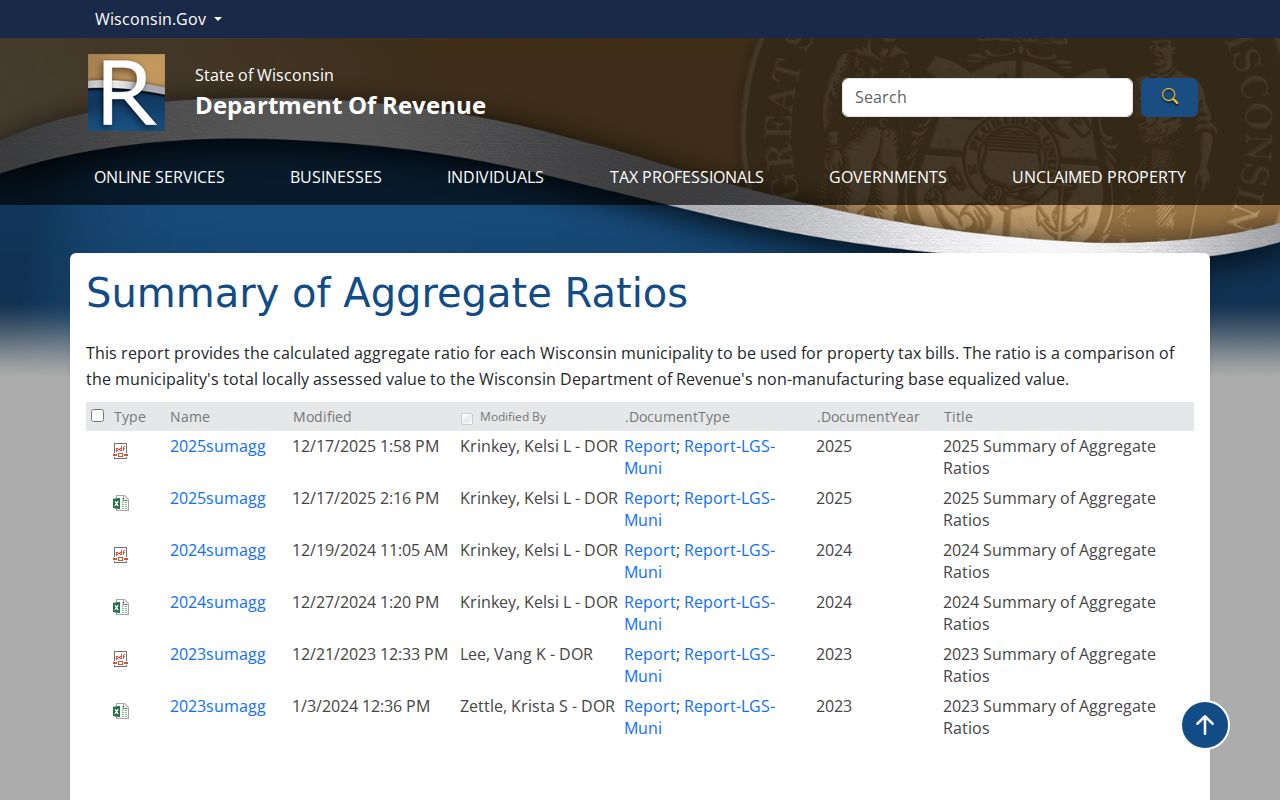
Do not mix up a parcel's own assessment with the municipal-level ratio. When the question is what the value fields mean, check them against the DOR property-owner guide and note the assessment year.
Monroe County Credits and Forms
The Monroe County Treasurer posts forms for lottery and gaming credits and change of address. It also covers building, fixture, or improvement information. These forms matter when a payment record needs context or a mailing address needs fixing. They are administrative tools. A filed form does not prove an owner qualifies for a credit. It also does not prove a change has taken effect. The county publishes no complete exemption list and no single countywide eligibility rule. The local assessor's instructions control.
Match each form to the parcel and the tax year. Follow the instructions from the office responsible for that record. Keep a copy of everything submitted. Never assume a credit is missing. A summary result may simply not display a field. The exact tax-result fields and each municipality's exemption list must be confirmed with the record custodian. Do this before you act on them.
When a form name appears in county materials, use that form rather than a substitute. The Treasurer's links cover the common cases. Anything beyond them starts with the local assessor for the parcel's municipality.
Delinquency and Monroe County Tax Deeds
An overdue bill is an administrative tax status. A tax deed is something else entirely: a recorded instrument. Ask the Treasurer first. For a tax-related ownership question in Monroe County, the Treasurer covers current delinquency or sale status. Then search the Register of Deeds. Look for a tax deed, a redemption, a release, or any later conveyance. A tax-bill result alone never shows that a transfer was completed.
Court action may surface through Wisconsin Circuit Court Access. The recorded land instrument remains the confirming record. Monroe County publishes no current tax-sale list or sale calendar. Contact the Treasurer directly rather than trusting an undated third-party notice.
Monroe County Mill Rates and Review
The Treasurer links a 2024 mill-rate resource. A mill rate reflects a tax district's levy framework, not a property's market price. The parcel's municipality and taxing districts shape the bill. So a rate pulled from another town or year cannot be applied to the property without checking the correct record. Wisconsin DOR's property-owner guide explains assessment notices and Board of Review. Monroe County posts no municipality-by-municipality open-book dates, objection forms, or Board of Review calendar. Read the current assessment notice. Then ask the local assessor for that year's procedure and schedule.
Appealing a Monroe County Assessment
A Monroe County owner who disputes an assessed value should start with the local municipal assessor. Read the notice for the property. Wisconsin DOR's property-owner guide lays out the assessment-review process and Board of Review. The local calendar and objection form come from the assessor, not from any countywide source. Ask which open-book and Board of Review dates apply to that municipality and year.
Gather the parcel's assessment notice, legal description, and recent property facts. Include any comparable records the assessor finds useful. A recorded sale can serve as evidence. Transfer consideration is not always a market transaction, though. Keep the review anchored to the assessment date and record year. Do not assume the most recent deed automatically sets the tax value.
One caution about totals. A bill can fold in amounts from multiple taxing districts and special charges. A change in total due does not mean the assessment itself moved. Compare the same parcel and tax year. Separate assessed value, credits, district rates, and charges. If an amount stays unclear, ask for the record detail and the office that supplied it. Do not compare two totals without their component lines.
Check the local window. No countywide Monroe County deadline was verified in the research. Use the date and instructions on the current assessment notice, then confirm the open-book and Board of Review schedule with the local assessor.